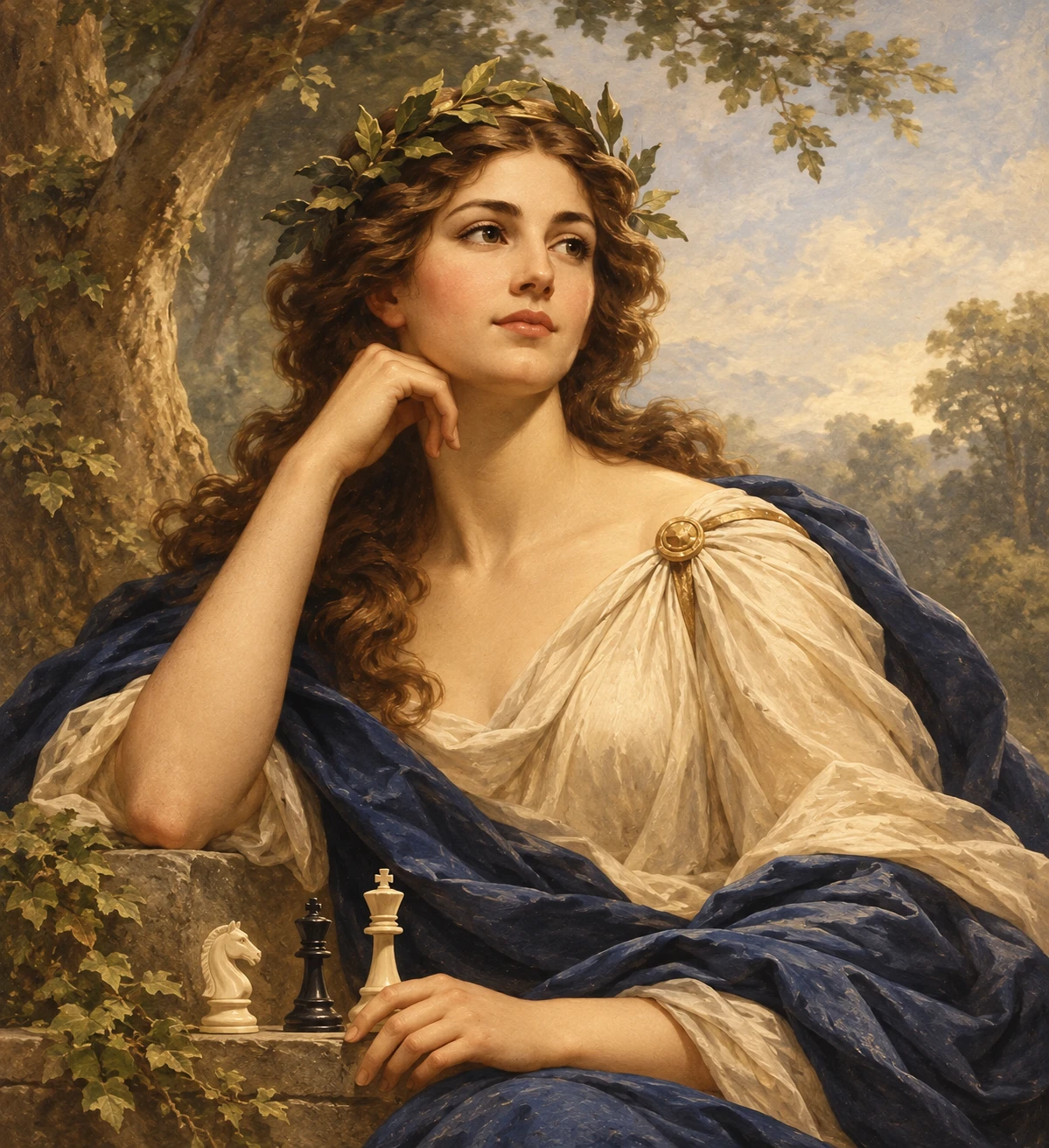
Portrait of Caissa, goddess of chess: a young woman crowned with laurel, in a white gown and blue cloak, resting her chin on her hand beside a knight and two kings
Caissa, the goddess of chess

Caissa

The goddess of chess was not born in antiquity, but in the pen of an eighteenth-century poet.

A Renaissance seed

In 1527 the Italian poet Marco Girolamo Vida published Scacchia Ludus, a Latin poem in which the gods of Olympus play a game of chess. Apollo and Mercury face each other across the board, and the crafty Mercury wins. The poem was widely read and translated, and it gave chess a mythology of its own.

Sir William Jones and the dryad

In 1763 a seventeen-year-old William Jones, later a celebrated scholar of languages, reworked Vida's idea into an English poem titled Caïssa. In his version Mars, god of war, falls in love with a shy Thracian dryad named Caissa, who rejects him. Mars turns to Euphron, the god of sport, who invents a new game, chess, as a gift. Won over by the game, Caissa returns his love, and chess passes from the gods to mortals.

The name Caissa appears to be Jones's own invention. It has no source in classical myth, yet it took hold so well that she is now universally known as the patron goddess of chess.

Caissa in the chess world

Players have invoked her ever since. A beautiful combination is said to be blessed by Caissa, and her name has been taken by chess clubs, magazines and tournaments around the world. In 1974 the Soviet program Kaissa won the first World Computer Chess Championship.

CaissaHub carries her name in the same spirit: a place for players who love the game.

Poems for Caissa

Verses on the goddess of chess.

The Dryad of the Board

She lived among the oaks of Thrace,
a dryad, quiet, cool, and wise,
till Mars came crashing through the trees
with all his battles in his eyes.

He brought her spears; she turned away.
He brought her crowns; she would not look.
So Mars went to the god of sport,
and Euphron, laughing, undertook

to carve for him a little field
of sixty-four squares, and there
to set two armies, dark and light,
to fight their battles, fierce and fair.

Here kings stand tall but hardly move,
the queen sweeps wide from rank to rank,
the knight leaps sideways over walls,
the bishop slips along the flank.

The pawns, the humble, march ahead
one patient step, and then one more,
and one who reaches the far side
becomes the thing it fought here for.

Caissa smiled. She took the board
and learned its every secret part,
and found in every quiet move
the beating of a warrior's heart.

So when you sit and face your foe
and hear no sound but clocks that tick,
remember: this is love, not war,
and every game, a lover's trick.

She waits in every rook's long file,
in every sacrifice made bold —
the goddess of the sixty-four,
forever young, forever old.

Something went wrong, and it has been reported to us. Reload the page 🗙